Trauma is the Norm (Did You Know That?)
Trauma Is the Norm: When the Pain You Minimized Is Still Shaping Your Stress, Anxiety, and Parenting
There is a reason this is one of the topics I get asked to speak on most often.
So many men and women are trying to manage stress, anxiety, irritability, burnout, emotional shutdown, and a harsh inner critic without realizing trauma may be part of the story.
Not because they are dramatic. Not because they are broken or flawed.
But because trauma is far more common than most of us were ever taught to see.
Around 70% of people globally will experience a potentially traumatic event in their lifetime. In the U.S., nearly two thirds of adults report at least one adverse childhood experience. Research also estimates childhood emotional neglect at about 18.4%, which is close to 1 in 5.
I’d argue that percent is even higher since the COVID pandemic. Whether you were impacted personally, or a person close to you was impacted, you have likely been impacted by trauma or secondary trauma.
So when I say trauma is the norm, I do not mean trauma is good, small, or something we should normalize in a minimizing way.
I mean this:
Trauma is common enough that many of us are living with its effects while assuming we should just be able to “move on.”
And that misunderstanding keeps us stuck in shame.
Trauma is not only the big obvious thing
When many people hear the word trauma, they think of one catastrophic event.
And yes, trauma can absolutely be one acute and overwhelming experience.
But trauma can also come through repeated stress, childhood chaos, emotional neglect, unpredictable caregiving, chronic criticism, betrayal, loss, medical trauma, spiritual harm, or living for years in survival mode.
SAMHSA defines trauma as an event, series of events, or set of circumstances experienced as physically or emotionally harmful or life threatening, with lasting adverse effects on well being.
That means trauma is not always loud.
Sometimes it is quiet.
Sometimes it is what happened.
Sometimes it is what never happened that should have.
You may not have had a story you would have called “bad enough.”
But if your nervous system learned to stay braced, overfunction, shut down, people-please, overthink, or scan for danger, there is often a reason.
Why this matters for stress and anxiety
One of the most confusing parts of unresolved trauma is that it often shows up in ways Christian women and men mislabel.
You might call it:
-Anxiety
-Perfectionism
-Control issues
-Overthinking
-Anger
-People pleasing
-Mom guilt
-Exhaustion
-Feeling emotionally numb
-Never being able to rest
But beneath those labels, your body may simply be doing what it learned to do to survive.
Trauma can leave your nervous system stuck in patterns of hyperarousal or shutdown. In plain language, that can look like feeling revved up, easily triggered, restless, tense, reactive, or unable to settle. Or it can look like going numb, checking out, feeling flat, disconnected, and exhausted. SAMHSA notes that trauma can have lasting effects on mental, physical, social, emotional, and spiritual well-being.
That is why some feel guilty for being “too much” and others feel ashamed for feeling “nothing.”
Both can be trauma responses. And both make sense in context.
The parenting connection no one talks about enough
This is where the conversation gets deeply personal.
Trauma does not stay in the past just because the event is over.
It can shape how you experience being a parent now.
It can influence how safe you feel in your own body.
It can affect your patience when your child is dysregulated.
It can make crying, conflict, mess, noise, or unpredictability feel bigger than they “should.”
It can intensify guilt.
It can make rest feel unsafe.
It can make you believe you are failing when your system is actually overloaded.
It can also shape your view of self as a parent, mom, or Christian.
You may find yourself thinking:
I should be handling this better.
Why am I so reactive?
Why do I need so much quiet?
Why am I so tired all the time?
Why does everyone else seem more patient than me?
What is wrong with me?
That last question is the one I want to gently interrupt.
Because often the better question is not What is wrong with me?
It is What happened to me, and how is that still affecting me now?
That shift matters.
It moves you from shame to understanding.
From self-attack to self-awareness.
From minimization to healing.
From shame to self-compassion.
Trauma can shape your parenting without defining it
If trauma is still active in your nervous system, you may notice it in parenting moments like these:
You go from calm to overwhelmed very quickly.
Your child’s needs feel relentless, even when you love them deeply.
You struggle to stay present because your mind is always scanning what is next.
You are deeply tender with your kids, but brutal with yourself.
You either overcorrect to avoid repeating your family story, or you freeze and do not know what to do.
You interpret your hard moments as proof that you are a bad parent.
But hard moments are not proof; they are often signals.
Signals that your body needs support.
Signals that your story deserves compassion.
Signals that healing work is not selfish. It is stewardship.
Trauma and faith can live in the same conversation
For Christian men and women, trauma can also affect the spiritual life in subtle ways.
You may still love God deeply and still find yourself struggling to trust, rest, receive comfort, or feel safe.
You may know the right verses and still feel anxious in your body.
You may believe God is good and still carry fear, shame, or hypervigilance.
That tension does not make you a weak Christian.
It makes you human.
Jesus told us plainly that in this world we would have trouble. John 16:33 does not deny the reality of pain. It tells the truth about it. And Romans 8:37 reminds us that in Christ, suffering does not get the final word. We are not defined by what happened to us.
At Prosper Counseling, we believe healing is not about pretending trauma did not matter.
It is about building capacity and resilience.
It is about understanding the nervous system God designed.
It is about pairing truth with gentleness.
It is about recognizing that redemption is not denial. Redemption is God meeting you honestly in what happened and bringing healing over time.
“I would argue the number of trauma is higher”
Clinically, I would argue the number feels even higher.
Not because I have better prevalence data than the research does, but because so many minimize their experiences. They say things like:
“It was not that bad.”
“Other people had it worse.”
“My parents did the best they could.”
“I do not know if it counts.”
“I should be over it by now.”
Sometimes those statements hold truth and complexity.
And sometimes they are also signs of how disconnected we have become from our own pain.
When we only count the most dramatic forms of trauma, we miss the quieter stories that still leave deep marks.
-Emotional neglect.
-Living in chronic stress.
-Growing up around unpredictability.
-Feeling unseen.
-Being loved but not emotionally attuned to.
-Learning early that your needs were too much.
Those experiences matter too.
What healing can look like in real life
Healing is rarely instant.
It often looks ordinary before it looks dramatic.
It can look like noticing your triggers sooner.
Taking a breath before reacting.
Letting yourself rest without earning it.
Learning to name what you feel.
Saying no without spiraling in guilt.
Getting support instead of just pushing harder.
Beginning to believe that your hard story does not disqualify you from peace.
This is the kind of healing that changes everything from the inside out.
Not because your children become easier.
Not because life stops being stressful.
But because your nervous system starts to experience more safety, more steadiness, and more room to choose a different response.
A final word
If this topic feels close to home, let this be your reminder:
Your stress may make more sense than you think.
Your anxiety may have roots, not just symptoms.
Your parenting struggles may be connected to pain you never learned how to name.
Your view of yourself may have been shaped by survival more than truth.
And none of that means you are broken beyond repair. It means your story deserves care.
At Prosper Counseling, we want to help you understand the overlap between trauma, anxiety, motherhood, faith, and the nervous system without shame.
Because trauma may be common. But so is the possibility of healing.
Take the Next Step Toward Peace
Ready for deeper support?Start Therapy with Prosper Counseling to begin your journey toward lasting mental health.
Purchase the Anxiety Course & Guide for $47 to get immediate, self-paced tools for your nervous system. This one-hour course includes a workbook with all the tools for the simple 3-Step Anxiety Reset process.
Looking for a Speaker? Currently booking for ministries, schools, and business retreats.
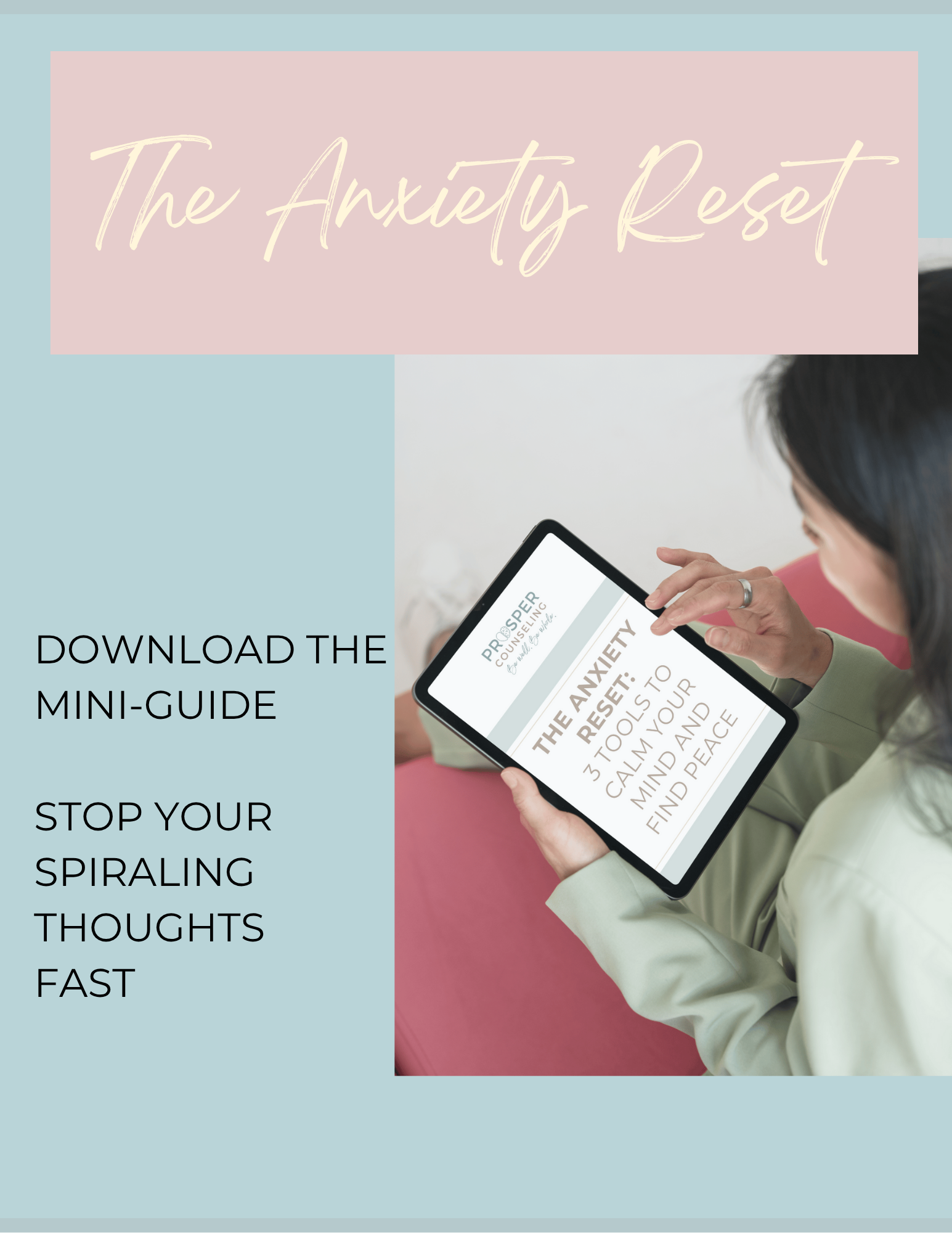
The Anxiety Reset Guide
Stop anxious spirals
Your nervous system is wired for rhythm, not rush. When you’re constantly jumping between kid activities, work responsibilities, cooking, cleaning, and family expectations, your body enters a state of survival mode. This guide gives you a starting point for emotional regulation and kicking guilt and shame to the curb.
It’s time to prosper in your well-being!
Serving Springfield, MO; St. Louis, MO; Kansas City, KS; Wichita, KS, and all surrounding metro areas in Kansas and Missouri.
Mental health and life coaching in all 50 states.