Are You Spoiling Your Kids? What Christian Parents in Missouri and Kansas Need to Know
Does Gift Giving Spoil Your Kids? What Research and Scripture Actually Say
Almost every parent asks this question at some point.
Usually not in a calm moment.
More often after a season of generosity, celebrations, or back to back birthdays, when the house feels full and your nervous system feels fried.
You love your kids.
You want to give good gifts.
And you also want to raise grounded, grateful, emotionally healthy humans.
So the questions creeps in.
+Am I giving too much?
+Am I creating entitlement?
+Am I setting them up for struggle later?
Let’s slow this conversation down, enough to break some things down.
Because the research and Scripture both offer a far steadier answer than fear-based parenting voices would suggest.
What Does It Actually Mean to “Spoil” a Child?
In research, the word spoiling is replaced with a more precise term: overindulgence.
Researchers typically describe three types:
1-Material overindulgence
Giving lots of toys, gifts, treats, or experiences.
2-Behavioral overindulgence
Low expectations, inconsistent limits, lack of follow through, or shielding children from natural consequences.
3-Relational overindulgence
Over rescuing, over protecting, prioritizing a child’s wants over all other relationships, or blurring parent child roles.
Here is where many parents are surprised.
Research does not consistently link material overindulgence to poor outcomes.
It does consistently link behavioral and relational overindulgence to challenges with anxiety, entitlement, emotional regulation, and resilience.
In other words, boundaries matter more than the number of gifts.
What the Research Actually Finds
Several studies have examined how different forms of indulgence affect children.
One study found that behavioral indulgence, not material giving, was associated with higher anxiety and depression in children.
Another found that children showed the best outcomes when parents were generous with material support while also maintaining clear expectations and limits.
Translation:
Giving does not spoil children.
Inconsistent boundaries do.
When Gift Giving Can Become a Problem
Material giving becomes more complicated when it starts carrying emotional weight it was never meant to hold.
Research shows children are more likely to become materialistic when gifts are used as:
• Rewards or punishments
• Proof of love
• A replacement for emotional presence
• A way to manage parental guilt or stress
Materialism is not about owning things.
It is about believing things create worth, safety, or love.
Children learn what matters by watching what carries emotional meaning in the home.
When connection, repair, and presence are consistent, gifts lose the power to define value.
A Grounded Way to Discern Your Yes and No
Researchers Jean Illsley Clarke and colleagues developed a reflection tool sometimes called the Test of Four. It encourages clear thinking, self-control and assessment of the child’s developmental stages and needs.
Before giving or doing something, ask:
• Will this keep my child from learning what they need at this age?
• Will this require a disproportionate amount of family resources?
• Does this benefit me more than my child?
• Could this unintentionally harm others or our family system?
A yes does not mean you are doing something wrong.
It simply invites intention instead of reaction.
What Scripture Tells Us About Giving
Jesus speaks directly to the heart of this concern.
Matthew 7:11
“If you then, though you are evil, know how to give good gifts to your children, how much more will your Father in heaven give good gifts to those who ask Him.”
Notice what this verse does not say.
It does not say good parents never give.
It does not say restraint equals righteousness.
It shows us a God who gives generously with wisdom and love.
As parents, we reflect God not by withholding out of fear, but by giving within the safety of relationship and structure.
Parenting From Steadiness, Not Guilt
If you are a high-functioning anxious parent, guilt often sneaks into decisions quietly.
You might give because you are tired.
Because things have been hard.To provide access to things you didn’t have growing up.
Because you want to make up for stress, illness, or disruption.
None of that makes you a bad parent.
But parenting from guilt often leads to confusion for kids.
Parenting from steadiness leads to safety.
A simple question to return to is this:
Am I giving from connection or from guilt?
A Practice You Can Try This Week
Pause. Notice where parenting pressure feels loud right now.
Practice. Choose one boundary to hold gently and consistently.
Promise. God gives wisdom freely when you ask.
Breath prayer
Inhale: God, You are a good Father
Exhale: Help me give with wisdom and love
Matthew 7:11
*Links to research in this article:
https://doi.org/10.1080/15374416.2013.782816
https://www.ncbi.nlm.nih.gov/pmc/articles/PMC5330549/
https://psycnet.apa.org/record/2012-07074-001
https://www.mdpi.com/2227-9067/10/3/451
https://www.mdpi.com/2227-9067/11/9/1132
https://pmc.ncbi.nlm.nih.gov/articles/PMC10683937/
https://www.mdpi.com/2076-328X/13/10/863
You Do Not Have to Figure This Out Alone
If parenting decisions feel heavy, confusing, or emotionally loaded, that is often a sign your nervous system needs support too.
We help parents learn how to lead from calm instead of constant self-doubt.
You are invited to schedule a free consult or download one of our free tools to help you parent with clarity, boundaries, and grace.
Know that you don’t have to live in fear of ruining your kids. You are allowed to enjoy giving gifts alongside structure, consistent boundaries, and attachment repair!
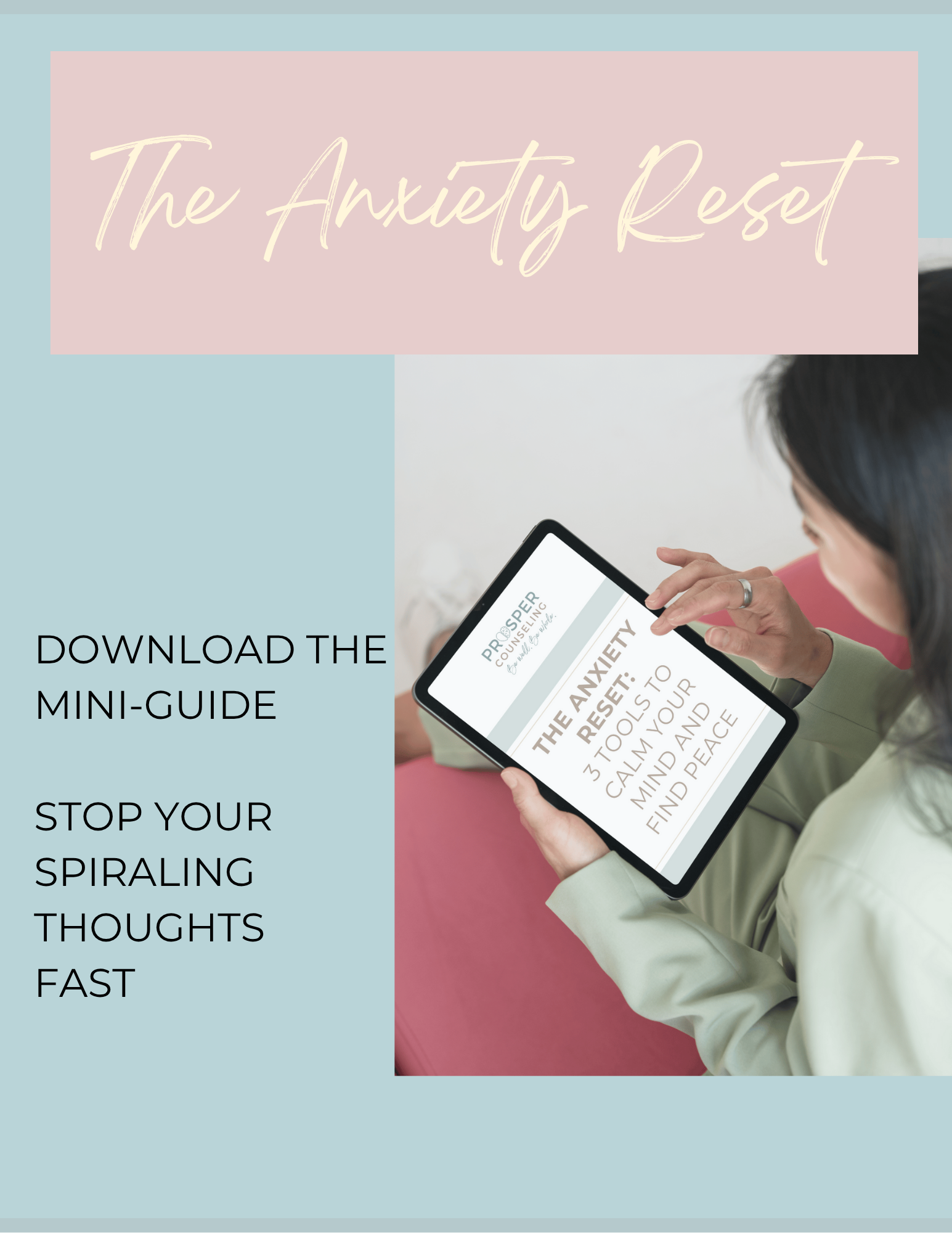
The Anxiety Reset Guide
Stop anxious spirals
Your nervous system is wired for rhythm, not rush. When you’re constantly jumping between kid activities, work responsibilities, cooking, cleaning, and family expectations, your body enters a state of survival mode. This guide gives you a starting point for emotional regulation and kicking guilt and shame to the curb.
Ready for More Support?
At Prosper Counseling, we integrate faith and evidence-based care so your body and beliefs work in the same direction. That includes anxiety therapy that honors physiology and story, and EMDR therapy online for Missouri and Kansas clients. EMDR (Eye Movement Desensitization and Reprocessing) helps your brain and body reprocess stuck emotions so that today’s triggers stop borrowing narratives from the past that make you feel burned out, unsafe, or dysregulated.
Parents in Missouri and Kansas are often looking for support with healing from their own childhood narrative or for a more holistic approach. Counseling is avaiable to work with individuals and couples on: communication, conflict, and parenting concerns.
Many clients find EMDR pairs beautifully with faith. If you’re still considering if therapy is a good fit for you, read to learn more about Anxiety Therapy and EMDR Therapy. You can book a free consultation at any time.
Order a copy of the book Prosper in Motherhood full of helpful and practical tools for your motherhood journey.
Read other blog posts on parenting that hurts when you mean well, activities do in the midwest including Branson, MO, Springfield, MO, and Northwest Arkansas.
Serving Springfield, MO; St. Louis, MO; Kansas City, KS; Wichita, KS, and all surrounding metro areas in Kansas and Missouri.
Mental health and life coaching in all 50 states.